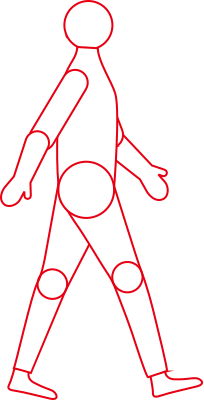
Single-leg standing
for improving your balance
Do three times a day, one minute for each leg.


Tips
If you require something to lean on, carefully place your hands or fingers on a table.


LOCOMO is a healthcare concept developed in Japan
that focuses on maintaining and improving mobility function.
“Locomotive syndrome” is a condition of reduced mobility due to disorders of the locomotor system.
“Locomotion” is another word for movement, which can then be modified into “locomotive” to mean having the ability to move. Locomotive syndrome refers to a condition in which that ability is insufficient or in decline. It is also sometimes abbreviated to just “locomo.” The comprehensive bodily system necessary for various “movements” such as standing, walking, and working is called the “locomotor system.” It consists of your bones, joints, muscles, and nerves. Locomotive syndrome is a condition in which your physical capabilities for actions like standing and walking (mobility) decline due to disorders in this system. As it progresses, the risk of requiring nursing care in the future increases.
Japan became a super-aged society earlier than other countries. To raise awareness of age-related declines in motor function and mobility, the concept of locomotive syndrome was introduced in Japan in 2007.

※ If you take appropriate measures, your mobility will improve again.

Three simple methods to determine whether you have LOCOMO
The “locomotive syndrome risk test” consists of three parts. If your results are poor for any one of these, you have locomotive syndrome.
(for assessing leg strength)

Prepare four seats of different heights – 40cm, 30cm, 20cm, and 10cm. Starting from 40cm, stand up from each, first with both legs, then with one leg.
SOURCE: Shingo Muranaga, Journal of the Showa Medical Association (2001) 61(3):362-367.
On both legs
Sit on the 40 cm seat, arms folded. Spread your legs to the width of your shoulders, with your shins at an angle of 70 degrees to the floor (in the case of the 40cm seat). Then stand up, without leaning back to gain momentum, and maintain posture for three seconds.

On one leg
If you can stand up from 40 cm height on both legs, next try it on one leg. Resume the basic posture, and raise either your right or left leg, bending the knee slightly. Stand up without leaning back to gain momentum, and maintain posture for three seconds.

1.Start with both legs from 40 cm height.
Start with both legs from 40 cm height. If you fail, you are at LS stage 3. If you succeed, try standing up on one leg from the same height.
2.If you succeed/fail in single-leg stand-up from 40 cm height.
Move on to testing one leg at a time from lower heights in decrements of 10 centimeters. The lowest height from which you can stand both on your left leg and on your right leg is your test result.
Starting from 30 cm height, stand up with both legs and move on to lower heights in decrements of 10 centimeters if you succeed. The lowest height from which you can stand on both legs is your test result.
[Relative difficulty of standing from each height]
40cm, both legs<30cm, both legs<20cm, both legs<10cm, both legs<40cm, one leg<30cm, one leg<20cm, one leg<10cm, one leg
LS stage1
Can’t stand up from 40 cm height on one leg or the other but can stand up from 20 cm height on both legs
Your mobility is starting to decline.
Your muscular strength and balance are starting to deteriorate, so you need to get into the habit of performing regular exercise, such as locomotion training. Also, take care to eat a balanced diet with plenty of protein and calcium.
LS stage2
Can’t stand up from 20 cm height on both legs but can stand up from 30 cm height
The decline in your mobility is progressing.
You’re at high risk of becoming unable to lead an independent lifestyle. In particular, if you’re also experiencing pain, you may be showing signs of a disease of the locomotor system, so it’s recommended you see an orthopaedist.
LS stage3
Can’t stand up from 30 cm height on both legs
The decline in your mobility has progressed to the point that your social participation is limited.
You’re at extremely high risk of becoming unable to lead an independent lifestyle. You may require treatment for a disease of the locomotor system, so it’s recommended you get diagnosed and treated by an orthopaedist.
(for assessing the length of your steps)

Total length of two steps (cm) ÷ your height (cm) = your two-step score
Decide your starting line and stand with the toes of both feet behind it.
Take two steps while striding as far as you can. Then align both feet. (If you lose your balance, treat the attempt as a failure and start over.)
Measure the length of your two steps (from the starting line to the tips of your toes where you stopped).
Do the test twice and record the better result.
Calculate your two-step score using the following formula.
SOURCE: Shingo Muranaga, et al, Journal of the Showa Medical Association 63, no. 3 (2003): 301–8.
LS stage1
1.1 or more but less than 1.3
Your mobility is starting to decline.
Your muscular strength and balance are starting to deteriorate, so you need to get into the habit of performing regular exercise, such as locomotion training. Also, take care to eat a balanced diet with plenty of protein and calcium.
LS stage2
0.9 or more but less than 1.1
The decline in your mobility is progressing.
You’re at high risk of becoming unable to lead an independent lifestyle. In particular, if you’re also experiencing pain, you may be showing signs of a disease of the locomotor system, so it’s recommended you see an orthopaedist.
LS stage3
Less than 0.9
The decline in your mobility has progressed to the point that your social participation is limited.
You’re at extremely high risk of becoming unable to lead an independent lifestyle. You may require treatment for a disease of the locomotor system, so it’s recommended you get diagnosed and treated by an orthopaedist.
(for assessing your physical condition and lifestyle)
This test assesses your risk level based on your physical condition and lifestyle.
Answer the following 25 questions to assess subjective symptoms related to your locomotor system.
 Download PDF
LS stage1
7 points or more but less than 16 points
Your mobility is starting to decline.
Your muscular strength and balance are starting to deteriorate, so you need to get into the habit of performing regular exercise, such as locomotion training. Also, take care to eat a balanced diet with plenty of protein and calcium.
LS stage2
16 points or more but less than 24 points
The decline in your mobility is progressing.
You’re at high risk of becoming unable to lead an independent lifestyle. In particular, if you’re also experiencing pain, you may be showing signs of a disease of the locomotor system, so it’s recommended you see an orthopaedist.
LS stage3
24 points or more
The decline in your mobility has progressed to the point that your social participation is limited.
You’re at extremely high risk of becoming unable to lead an independent lifestyle. You may require treatment for a disease of the locomotor system, so it’s recommended you get diagnosed and treated by an orthopaedist.

Locomotion training for the legs and lower back.
Keep your lower body fit for life by making locomotion training a habit. Locomotion training (LT) consists of just two exercises: one-leg stands and squats.
Do three times a day, one minute for each leg.
Tips
If you require something to lean on, carefully place your hands or fingers on a table.
Repeat 5-6 times in sync with deep breathing. Do three times a day.
1.Stand with your legs shoulder-width apart.

2.Lower your body while pushing your buttocks back. Take over 2-3 seconds to bend your knees, then return to the standing position slowly.

If unable to do squats:
Sit on a chair with your hands on a table and repeatedly stand up and sit down. If you can do the exercise without touching, hold your hands just above the table.

Tips
To healthcare professionals and specialists
To expand Japan-originated Locomotive Syndrome prevention and awareness activities worldwide, an international working group has been established. We are seeking physicians, research institutions, and partners willing to collaborate in these activities. If you are interested, please contact us using the inquiry form.
Contact

